Leeks in a Light Cheese sauce with Tempura Battered Penclawdd Cockles
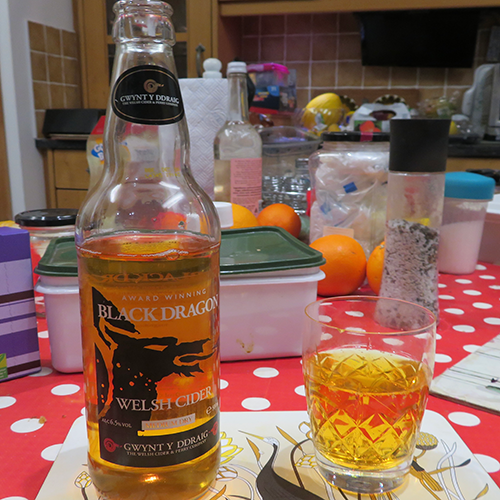
(Served with chilled Gwynt y Ddraig cider)

When I was a child, Dad had a large barn where he kept our deep-litter chickens. We fed them regular chicken food supplemented with copious grass cuttings and whatever else was available. I used to love feeding the chickens, who happily clucked around me to get the first handfuls of food each morning.
Every now and then, Dad would notice that the shells of our chickens’ eggs were becoming fragile. He would then drive us to Swansea to visit the famous cockle beds in Penclawdd, which have been harvested since Roman times.
Armed with a rake and a riddle, we would spend several happy hours raking up cockles from the sand beds, rinsing them in the riddle in seawater, and taking them home in a large hessian sack.
Looking back, almost every day out we had seemed to be work-related, but those were existential times, and it was also exciting when you’re just eight years old.
Back on our smallholding, we would carefully rinse a saucepan full of cockles and leave them overnight in salty water so that the cockles would get rid of any grit and, I suppose, empty their little cockle bowels.
The next day, Mum would rinse the cockles again and then drop them in a pan of boiling water. After cooking them for several minutes, Mum would discard any still-closed cockles, which indicated they were dead, and carefully remove the rest from their shells before eating them with black pepper and malt vinegar.
The remainder of the cockles would be rinsed off and cooked quickly in a large vat in the shed. Once cooled, the cockles were immediately fed to the chickens whilst all the shells were gathered and burnt in a metal tray on a bonfire, which weakened the shells. Dad would subsequently put the shells in a sack and bash them with a sledgehammer before feeding them to the chickens as a calcium supplement.
Thus began my lifelong love of fresh cockles, and below is one of my favorite cockle meals, which combines my love of eating cockles, growing leeks, and drinking the odd glass of a Welsh cider called Gwynt y Ddraig (Black Dragon).
Ingredients for two meals
150 g of fresh cooked cockles, I get mine from Abergavenny market on a Tuesday
2 medium sized home-grown leeks, thinly sliced
A cupful of grated strongly flavoured cheddar cheese
A large knob of butter and about 2 tablespoons of olive oil
About a tablespoon of plain flour, see methods
A tablespoon of tempura batter flour
Two servings of freshly cooked spaghetti.
Method
I’m lucky in that I grow my own leeks and, being organic, they have a very mild flavour and last for months in the garden. The first job is to dig up the leeks , cut off the roots and about 2/3 of the leaves then slice into half inch pieces. Put the leeks in a saucepan and cover with semi skimmed milk and cook until tender being careful to avoid burning the bottom of the saucepan. Set this aside.
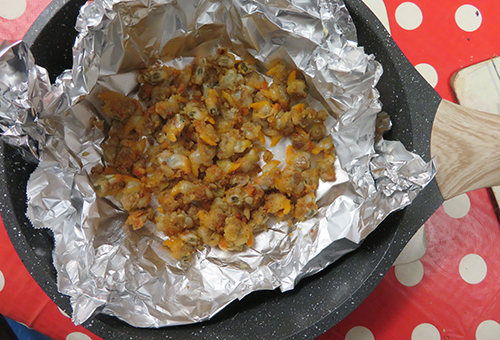
Take another saucepan and add the butter and olive oil and heat until it starts to sizzle then sprinkle in the cockles which have been tossed in tempura batter. Fry in small batches so that the cockles don’t stick together then set aside on aluminium foil in a warm oven.
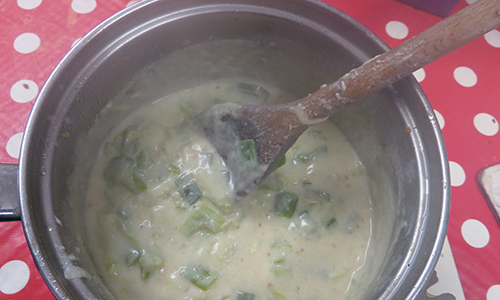
Using the same pan in which the cockles have been fried, add just enough plain flour to absorb the butter and oil mixture and make a roux with the milk and cooked leeks then add grated cheddar cheese to make a cheesy leek sauce.
In the meantime, cook the fresh spaghetti, drain and plate up then spoon on the leek and cheese sauce followed by the crispy Penclawdd cockles.
Serve with a wedge of lemon and a small glass of chilled cider, my favourite being Gwynt y Ddraig Black Dragon cider.
This is a really tasty meal and any leftover leek and cheese sauce freezes well. I tend to cook enough for two people and have the same meal the next day, but I can never keep my hands off the crispy cockles so tend to finish them off with a second glass of cider the same evening.
Enjoy!
As a footnote, some people don’t like cockles and you can make the above without cockles. Either way, it’s a very tasty supper.