
Hedgewitchery Tomato Soup

Preparation time: 7-8 months growing.
Making the puree: 2 hours
Making the soup: 1 hour
Eating: 8 minutes (or less!)
I believe that growing, harvesting, cooking, and eating food can and should be a sacred ritual. Sadly, few of us have the time or resources to ritualise every meal but when entertaining special friends, I do make an effort. Tomato soup is one such meal that I have made and refined over six decades.
I am fortunate enough to have a large garden where I can grow my own vegetables, and I particularly like tomatoes since they always taste so much sweeter than those you can buy in supermarkets.
Tomatoes also have special memories for me since my father used to grow them during the Second World War, and one of my fondest childhood memories is of pricking out tomato seedlings with my dad and potting them on. The tomato season would begin with dad taking us to a local mountain called the Sugarloaf where we would all collect sheep droppings to be used in fertilising his tomato plants. My father had a very old milk churn, (still in use) in which the sheep droppings were placed and then filled with water. The churn would occasionally be topped up with more droppings as the liquid diluted.
Growing tomatoes is, therefore, very much in my metaphysical DNA, as is my mother’s way of making lush tomato soup modified by me over time as kitchen gadgets became affordable.


Growing tomatoes
I have grown tomatoes both in a greenhouse and outdoors, the latter being sweeter but more prone to heart-breaking blight, often just as they are about to ripen. In 2024, such was the ambient humidity that my greenhouse tomatoes developed blight for the first time in over forty years. So, like life itself, there is never any certainty. Fortunately, homemade tomato puree freezes extremely well and lasts for years. I am still making soup from a massive crop of tomatoes I grew in 2018 when we had an exceptionally hot summer.
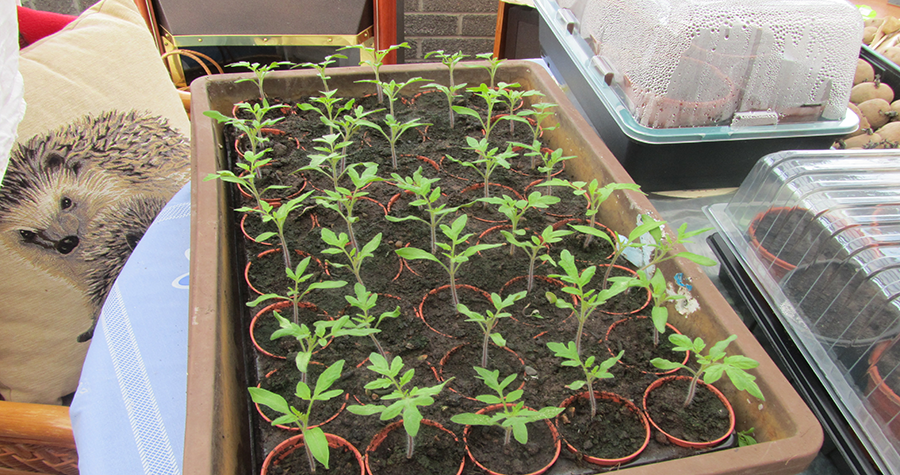
The time of planting tomato seed varies from season to season. Although it sounds nonsensical, I plant them when it feels right in my bladder and gut, usually in early March. I have grown many varieties over the years but tend to stick to Ailsa Craig, Money Maker, Gardener’s Delight, and, recently, a very large variety called Gigantoma, which is extremely sweet for eating raw and for making puree. I use an incubator and grow the seeds in my conservatory until they are large enough to put into small pots.
It’s best to repot several times before planting and growing-on, either outside or in a greenhouse depending on the variety. By early September you will be rewarded with wonderful, sweet tomatoes.


Making Tomato Puree
Choose a calm, sunny day and pick the crop when it is still warm. Rinse the tomatoes, remove the stems, and cut them into halves, or just squish by hand. Then place in a 12-litre stainless steel pan, filling it to the nine-litre mark. I make puree in bulk. There is no need to add water, but I use a potato masher first, then a hand-held liquidiser. I add tomatoes until the mush reaches the nine-litre mark. Next, I cook the mashed tomatoes till they are reduced to about 3.5 litres.
Tomatoes contain a magical organic compound called lycopene, which apparently has antioxidant and antimutagenic properties, particularly for prostate cancer. What’s cool, too, is that cooking tomatoes increases the availability of lycopene, and you can’t overdose on it.
The skins contain five times more lycopene than the pulp, and, until a few years ago, once I had prepared the concentrated mush, I would strain it to remove the skins. But one day, I wondered if my super-powered liquidiser could zap the mush into a smooth puree. It did, so I have no waste now, and my puree contains masses of lycopene. It is also a much sweeter product.
Next, cool the puree and freeze in zip-lock bags, making sure all air is removed.
Making the soup
For me, cooking is partly a science and an art that needs focused attention, almost like a prayer. When making soup, I ensure guests know that the kitchen is temporarily out of bounds since I become antsy if interrupted—not even Jasper is welcome!
I vary the cooking method depending on whether my guests are vegetarian, but my favourite version is as follows.

Ingredients
1 bag of defrosted puree, the amount depending on the number of guests
2 finely-sliced, medium-sized red onions (preferably homegrown)
A pack of nitrite-free organic streaky bacon,
Dried lemon thyme to taste (see Method below)
Semi-skimmed filtered milk (to create a custard-like consistency – see Method below)
Plain flour (to absorb the fat and create a custard-like roux)
Organic unsalted French butter or olive oil
Himalayan salt and freshly ground black pepper
Method
Cut the bacon strips in half and fry them in their own fat until crispy and irresistible. (That’s why I cook the whole pack!) Then set aside for later.
Next, sauté the onions in bacon fat, butter, olive oil, or a mixture of all three until caramelised. I use 1/3rd bacon fat, 1/3rd butter, and 1/3rd olive oil. Vegetarians can omit the bacon and just use olive oil to sauté the onions. As a side note, olive oil increases lycopene absorption, so bearing this in mind, olive oil may be best.
Now sprinkle just enough flour into the frying pan to absorb the fat/oil, and make a thick roux with the semi-skimmed milk.
Transfer the onion roux into a saucepan and add the defrosted puree. The mixture will curdle, but don’t panic; just bring the mixture to a boil and simmer, adding more milk to produce a custard-like consistency.
A lush meal in itself
Add dried lemon thyme—the amount is a personal choice, but don’t overdo it since the soup is best served the next day when the flavours become more intense after remaining in the fridge overnight. The final step is to pour the mixture into a liquidiser and zap it until you have a creamy mixture and no visible bits of onion. Add salt to taste and cool before leaving to rest overnight in a glass dish in the fridge.
Next day, allow at least three large scoops of soup per person (I actually serve two. but guests will want seconds!) The soup will thicken overnight so you may need to add more milk. You can just serve the soup with a sprinkle of black pepper, garlic bread, and maybe a swirl of cream. But my favourite is serving the soup in a wide soup bowl with a large scoop of mashed homegrown potatoes.
Press the bacon pieces into the potato and, using the bacon as a spoon, take a blob of potato and dip it into the soup.
Enjoy
